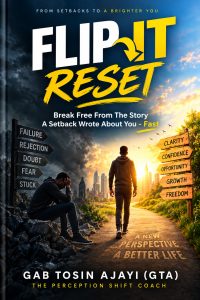
The Flip It Reset
Stop letting one bad experience quietly decide what you do, what you avoid, and what you believe you’re capable of.
Hey.
Grab a seat.
Let me ask you something.
Is there something that happened to you that you still haven’t completely moved past?
Maybe you failed at something. Maybe someone rejected you. Maybe somebody embarrassed you. Maybe you trusted the wrong person. Maybe you tried something, gave it everything you had, and it still didn’t work. Maybe somebody said something to you years ago that they probably don’t even remember saying.
But you remember.
And somewhere along the way, that experience became more than something that happened. It became a sentence you keep carrying around.
“I’m not good at this.” “People like me don’t get opportunities like that.” “I always mess things up.” “I’d rather not try again.” “That’s just who I am.”
What happened is one thing.
What you decided it means about you is another.
That difference can quietly change the direction of your life. Because sometimes the thing holding you back isn’t what happened. It’s the meaning you’ve been carrying ever since.
That’s what The Flip It Reset was created to help you change.
You may not be lazy. You may be protecting yourself.
Let me tell you something about me.
For a long time, if I tried something and it didn’t work — twice, maybe three times — a little voice in my head would show up.
“See? You’re just not good at this.” “Maybe this isn’t for you.” “Go try something else.”
So I would. New idea. New project. Clean start. And honestly, from the outside, it could look like I was ambitious. Always trying something new. Always moving.
But underneath that? Sometimes I was just running away before I had to find out whether I could actually get good at something. Because quitting early has one very convenient advantage:
You never have to fail again.
You also never have to find out what might have happened if you’d stayed.
And it wasn’t only about business or work. If someone said something that stung, I could take it home with me. Replay it. Analyze it. Read meaning into it. Turn eleven seconds of somebody’s words into three days of mental cinema. And the crazy part? The other person had probably forgotten the conversation. I hadn’t. I was still living in it.
I don’t do those things the same way anymore. Not because I suddenly became tougher. Not because I learned how to “just believe in myself.” And definitely not because bad things stopped happening.
I learned to question the meaning I was attaching to what happened. That changed the way I responded. And that changed what I did next.
Something can happen once — and still influence you for years.
Think about how quickly this happens.
One event. One interpretation. Then another. And another. Until eventually the interpretation becomes a story. The story becomes a rule. The rule starts influencing your choices. And after you’ve lived by it long enough, it starts feeling like your personality.
You stop saying “something happened to me.” You start saying:
“This is just how I am.”
And that’s where things get expensive. Because now the past isn’t just a memory.
It’s driving your car for you.
You may think you’re making today’s decisions. But sometimes you’re simply obeying yesterday’s conclusion.
And what if the problem isn’t you?
What if you’re not broken? Not lazy? Not incapable? Not “just not that kind of person”?
What if somewhere along the way, your brain learned a story that helped you make sense of something painful — and you’ve simply been carrying that story long after the situation changed?
That’s an important distinction. Because if the problem is “I’m broken,” then you need to fix yourself. But if the problem is “I’ve been carrying an old conclusion,” you can work with that. You can examine it. Question it. Test it. And choose what you want to do with it.
That is the idea behind The Flip It Reset.
You don’t need to pretend the bad thing never happened.
This isn’t about positive thinking. It isn’t about pretending everything is fine. It isn’t about forcing yourself to call something painful “a blessing.” And it certainly isn’t about blaming yourself for how you’ve reacted to difficult experiences.
The thing happened. We’re not rewriting history. We’re asking a different question:
Is the meaning I’ve been carrying really the only meaning this experience can have?
Because you don’t have to deny what happened to stop being controlled by it. You don’t have to love what happened. You don’t have to pretend it didn’t hurt. You simply need enough distance to look at what happened, examine the story you’ve built around it, and decide what you’re going to do next.
The real problem is what happens between the event and your next move.
Most advice tells you to change your mindset. Fine. But what does that actually mean when somebody rejects you tomorrow? What do you do when a client says no? When your idea fails? When somebody criticizes you? When you make a stupid mistake?
You can’t just shout “POSITIVE MINDSET!” at your brain and expect everything to magically rearrange itself. You need a process you can actually use. That’s what FLIP IT gives you.
It takes you from what happened → to what you told yourself it meant → to what that meaning has been making you do → to what you can choose to do differently now.
And at the centre of the process is a specific 3-Step Reframe Move.
I’m deliberately not going to give you the entire thing on this page. Not because it’s some mysterious secret — it isn’t. It’s actually straightforward once you see it. But there’s a difference between hearing three steps and being guided through them using something that actually happened in your life.
That’s what you’ll do inside. You won’t be working with somebody else’s imaginary problem. You’ll work with yours.
Here’s what actually changes when you use it: an old experience stops automatically deciding your next move.
You hesitate less. You stop abandoning something the moment it gets difficult. You become willing to try again. You speak when you’d normally stay quiet. Every time that happens, you collect new evidence about yourself — “I was scared, but I did it.” “It didn’t work, but I didn’t quit.” “They said no, but I survived.”
That evidence rebuilds something repeated avoidance quietly wears down: your trust in yourself. And that gives you something bigger than confidence.
Freedom.
- The freedom to try.
- The freedom to change direction without calling yourself a failure.
- The freedom to hear “no” without deciding it means “never.”
- The freedom to make a mistake without making yourself the mistake.
- The freedom to look at an old chapter and say: “That happened. But it doesn’t get to decide what happens next.”
This isn’t about becoming fearless.
You’re still going to feel nervous. You will still get rejected. Some ideas will still fail. The goal isn’t to become some permanently confident human who walks around with motivational music playing in the background.
The goal is much more useful:
To stop automatically letting an old experience decide your next move.
Imagine catching yourself in the moment and asking: “Am I responding to what’s happening right now — or am I reacting to something that happened before?”
That pause creates room. And inside that room is something you’ve probably needed for a long time: choice.
What you’ll actually do inside
This isn’t a book you’re supposed to read, nod at, and forget about three days later. You’ll use the process on one real experience from your own life. Here’s what you’ll work with:
The Camera Test
Learn to separate what actually happened from everything your mind added on top of it.
The Clean Fact
Strip the situation down to what you can actually say happened — no drama, no assumptions.
The Story Audit
Identify the story you’ve been repeating and the conclusions you’ve quietly been living by.
The Reframe Move
Work through the 3-step core engine of FLIP IT to find a more useful way forward.
The Evidence Check
Separate what you actually know from what you’ve simply assumed to be true.
The If-Then Plan
Turn a new perspective into a specific next action instead of falling into the old pattern.
The 60-Second FLIP
A faster version for the moment an old reaction starts kicking in.
Your One-Page Case File
A personal reference you can return to whenever that old story tries to take the wheel again.
Who is this for?
The Flip It Reset is for you if you’ve ever caught yourself thinking:
- “I used to be more confident.”
- “Every time I start something, something happens and I lose momentum.”
- “I know what I should do. I just can’t seem to make myself do it.”
- “Maybe I’m just not cut out for this.”
- “I’ve tried before.”
- “People like me don’t…”
If one of those sentences feels uncomfortably familiar, pay attention. You may not need more motivation. You may need to examine the story sitting underneath the behaviour.
And no, I’m not going to fake a wall of testimonials.
If you’re one of the early people getting The Flip It Reset, you’re not going to see a page full of suspiciously perfect testimonials telling you how this changed someone’s life in 48 hours. I’m not going to make those up.
Instead, look at the method itself. Look at the problem it addresses. And most importantly — try it on something real. The real test isn’t whether this page sounds good. It’s what happens when you take one experience you’ve been carrying and finally look at it differently.
Here’s what you get today
| The complete guided FLIP IT process — event to next move | ₦8,000 |
| The 3-Step Reframe Move (the core engine) | ₦6,000 |
| The Camera Test, Clean Fact & Story Audit | ₦3,500 |
| The Evidence Check | ₦2,000 |
| The If-Then Plan | ₦2,000 |
| The 60-Second FLIP | ₦2,500 |
| The One-Page Case File | ₦1,500 |
| Core product total | ₦25,500 |
Founding-reader launch price
The regular price for The Flip It Reset is ₦20,000.
But because you’re here at the beginning, the first 50 buyers get the founding-reader launch price of ₦12,500 — ₦7,500 less than the regular price, on a product already worth more than double that once you count what’s inside.
Here’s why it’s genuinely limited to 50, and not just a number picked to sound urgent: the first 50 buyers also get a reply from me personally — not automated — on the FLIP they submit through the workbook. That’s a real constraint. I can read and respond to 50 people’s work properly. I can’t do that for an unlimited list, which is exactly why the founding-reader price closes when the 50 spots do.
Once those 50 are gone, that offer is gone with them, and the price starts climbing toward the regular ₦20,000 as the launch continues. So if you’ve been thinking “I’ll get it later” — later costs more, and later doesn’t include a reply from me on your own FLIP.
The first 50 also get all five launch bonuses
These aren’t filler to make the offer look bigger. Each one helps you move from understanding FLIP IT to actually using it when life happens.
Bonus 1 — The Flip It Reset Workbook
₦4,500A structured place to run your own experience through the full process — and the workbook your personal-reply offer above is tied to.
Bonus 2 — The 60-Second FLIP Emergency Cards
₦3,000Ten pocket-sized prompt cards for the exact moment an old reaction kicks in — after a rejection email, before a hard conversation, right after a mistake.
Bonus 3 — The Flip It Story Library
₦3,500Twelve common limiting stories, each run through the Reframe Move — so you can see the method applied before you apply it yourself.
Bonus 4 — The Flip It Trigger List
₦2,500A short diagnostic to spot the specific situations most likely to set your old story off, so you catch it earlier next time.
Bonus 5 — The 7-Day Flip It Practice Challenge
₦3,000One short prompt a day for seven days, to build the habit of catching a story in real time.
| Core FLIP IT Reset product | ₦25,500 |
| 5 launch bonuses | ₦16,500 |
| Total value | ₦42,000 |
Plus all 5 launch bonuses (₦16,500 value) — and a personal reply from me on your first FLIP.
Get The Flip It Reset →You get immediate access. One payment. And a process you can come back to whenever an old story starts trying to take the wheel again.
Try it without the risk
Don’t take my word for it. Pick one real experience from your life. Actually work through the FLIP IT process. Give it a genuine shot.
And if within 30 days you decide it’s not for you, ask for your money back. No interrogation, no awkward explanation, no drama.
[Insert your actual refund terms here before publishing.]
But here’s the question I really want you to answer…
What’s the one story you’ve been carrying? Not every painful thing that’s ever happened to you. Just one. The one that keeps showing up. The one that whispers “don’t try,” “don’t trust them,” “don’t take the risk,” “people like you don’t get to do things like that.”
Maybe that story made sense once. Maybe it protected you. Maybe you needed it at the time. But here’s something worth considering:
A story can make perfect sense at one point in your life and still be completely wrong for the life you’re trying to build now.
You don’t have to hate the old version of you for believing it. You don’t have to pretend the past didn’t happen. You simply get to ask:
Is this still the story I want making my decisions for me?
Because the past hasn’t changed. But your relationship with it can. And sometimes that’s where the next chapter begins.
P.S. — Honestly, putting some of this on a sales page feels a little awkward. It’s not exactly fun admitting how many good ideas you quit on early, or how many times I replayed an eleven-second conversation like it was a feature-length movie.
But that’s kind of the point. The stories we’re most reluctant to examine are often the ones quietly running the show.
So if you already know the one I’m talking about — don’t try to fix your entire life today. Take one story. Run it through the process. See what happens.
Worst case? You spend ₦12,500 and some time looking at something you’ve probably spent far more time carrying than it deserves. Best case? You stop letting an old version of the story make decisions for the current version of you — and you get a real reply from me on your first FLIP, because you were one of the 50 who got here in time.
After the 50 spots close, the price rises and that offer closes with it.